

How To Win Friends And Influence People Barnes And Noble
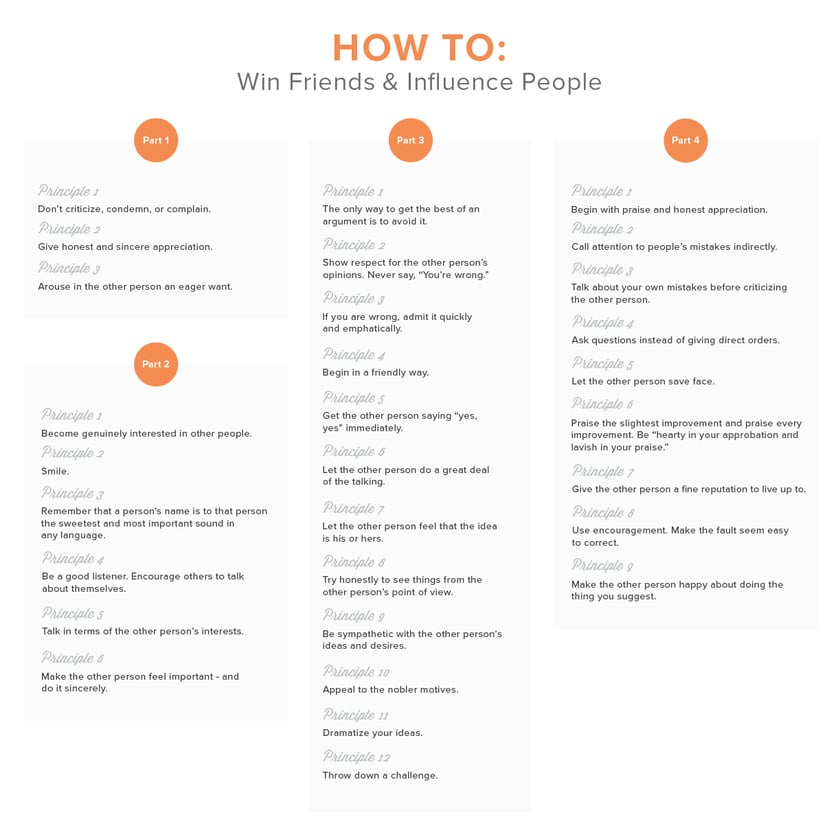
As a salesman at one point in his life, writer Dale Carnegie fabricated his sales territory the national leader for the firm he worked for. Carnegie somewhen ended his sales career and taught public speaking, earning up to $500 every calendar week -- the equivalent of $11,800 today. Even Warren Buffet, one of the nigh successful investors of the 20th century, took Carnegie'south course at age 20. Fortunately for the states, notwithstanding lessons were packaged into the now famous book,How to Win Friends and Influence People. But how do nosotros find time to read and think all 214 pages? Nigh of us don't. The volume becomes another item on that excess of to-dos we never seem to go to. That'due south why we summarized the entire book for you. In fact, here is a quick snapshot of all 30 principles. (click to enlarge) To capture the full lessons behind each of Carnegie's principles (which are listed below), leap or scroll downwards for quick summaries, tweet-worthy quotes, and practise exercises. 1. Primal Techniques in Handling People 2. Six Ways to Make People Like You 3. How to Win People To Your Style of Thinking 4. Be a Leader: How to Modify People The most successful leaders all take 1 thing in common: They've read How to Win Friends and Influence People.
Principle Overview: Carnegie explains that he once attended a dinner political party where he met a botanist whom he plant to exist absolutely fascinating. He listened for hours with excitement as the botanist spoke of exotic plants and indoor gardens, until the party ended and everyone left. Before leaving, the botanist told the host of the dinner party that Carnegie was a "most interesting conversationalist" and gave him several compliments. Of grade, Carnegie had inappreciably said anything at all. What he had washed was listen intently. He listened because he was genuinely interested. "And so I had him thinking of me as a good conversationalist when, in reality, I had been merely a good listener and had encouraged him to talk," Carnegie notes. Even the most ill-tempered person, the most tearing critic, will often be subdued in the presence of a patient, sympathetic listener. Take for example, a shop clerk. If the clerk constantly interrupts and irritates customers, those customers are more than likely to start arguments and bring frustrations and complaints to the store director. But a clerk who is willing to listen could calm fifty-fifty a customer who storms in already angry. Most of united states are so concerned with what nosotros are going to say next that we don't truly listen when someone else is speaking. Yet, nearly people would adopt a good listener to a good talker.
Carnegie describes a story from a homo named Edward Chalif, who was planning to ask the president of one of the largest corporations in America to pay for his son to go on a Boy Scout trip. Before Mr. Chalif went to see him, he had heard that this man had drawn up a check for a meg dollars, and that after it was canceled, he had had it framed. Upon meeting the homo, he mentioned how much he admired the check and would love to see it. The homo was thrilled! He talked almost the check for some time, until he realized he hadn't asked why Mr. Chalif was in that location to see him. When Mr. Chalif mentioned his request, the homo agreed without any questions and even offered to fund the trip for several other boys as well. Mr. Chalif later explained, "If I hadn't found out what he was interested in, and got him warmed up first, I wouldn't have found him ane-tenth as piece of cake to approach." Talking in terms of the other person's interests benefits both parties. How oftentimes do we find someone who looks very down, or bored - perhaps someone whose job is very repetitive or someone whose boss doesn't requite him or her much recognition? Possibly it's a store clerk, or the mailman, or our hair dresser. What could nosotros say to that person to cheer them up? Nosotros could think of something virtually them that we honestly admire. This might sometimes be difficult with a stranger, just nosotros should push ourselves to recall of something, and mention it to them. When Carnegie describes having this type of interactions with a stranger, he notes that many people take asked him what he was trying to get out of the person. His response:

Instead of starting with "You're wrong," what if we were to say, "Well at present, I thought otherwise, but I may be wrong. If I am wrong, I want to know why. Let'south examine the facts." The latter approach becomes disarming, and oft causes the other person to be much more reasonable, or even thank united states of america for having an agreement attitude. It also (hopefully) inspires our opponent to be but as fair and open-minded as we are. In fact, it's really not the ideas themselves that are so important to us, only our self-esteem, which is threatened when nosotros are told that we're wrong. Without our egos threatened, we may go very open to exploring new possibilities. Exercise Principle 2: Next time y'all find yourself condign frustrated or disagreeing with another person'south perspective, stop yourself from shaking your head, and adjust how y'all phrase your opinion: "No, you're wrong." ✓ "Why exercise you run across it that mode?" "No, that's the incorrect way to tackle." ✓ "Why do you recollect that'southward the best option to pursue?" You lot might even ask the other person for permission to share your perspective on the affair, which readies the other person to mind to your ideas in a less critical mindset. Carnegie tells a story of taking his dog to the park without a muzzle or a leash, and running into a law officer who scolded him, as this was against the law. The next few times Carnegie took his canis familiaris out, he kept him on a leash, but the dog didn't like information technology. So the next fourth dimension, Carnegie let the dog run free. When he ran into that same police officeholder, he knew he would be in problem. Instead of waiting for the police force officer to starting time reprimanding him, he spoke upwardly, saying that the officer had caught him red-handed, he was guilty and had no excuses, that the officer had already warned him. The policeman responded in a soft tone, told Carnegie he was overreacting, and that he should accept his dog to the other side of the hill where he wouldn't see him. If we know we're going to be rebuked anyway, isn't it far better to beat out the other person to information technology and do it ourselves? Through Carnegie's quick and enthusiastic admission of fault, he gave the police officer a feeling of importance. After that, the just manner the policeman could nourish his cocky-esteem was to accept a forgiving attitude and show mercy.

Business executives have learned that it pays to be friendly to strikers, that they are able to shift the strikers' perspectives and win their loyalty past addressing their needs equally friends and peers, instead of suppressing their voices and acting as dominants. Practice Principle four: When you lot find yourself nigh to scold your children, deed as a domineering boss, or nag your husband or wife, endeavour softening your arroyo past opening with a friendly conversation and keeping a calm tone. Ask how your husband's piece of work presentation went, or ask your employee for her thoughts on your terminal team meeting. Have at to the lowest degree five minutes of pleasant chat before yous bring up the outcome at hand. When talking with people, we should never begin with the points on which we disagree. We should starting time past emphasizing the things on which we agree, and be sure to convey that we're both striving for the same result - our differences are in method, but not purpose. The fundamental is to keep our opponent from proverb "no," as this is a very difficult sentiment to overcome. As soon equally someone says "no," all of her pride rests upon her existence consistent with that "no." When a person says "no," she immediately withdraws herself and guards against acceptance. What we desire to practice instead is get the person saying "aye" as before long every bit possible. This starts the person moving in the affirmative direction where no withdrawal takes place. Our opponent at present has a very accepting, open attitude. Socrates has become very famous for the "Socratic method," past which one asks another person questions with which they accept to concur.

Exercise Principle 6: Fight the urge to talk about yourself by learning to be comfortable with short silences in chat. We're often tempted to jump in and talk about ourselves when the other person stops talking, but if we stay quiet and expect for them to keep talking, chances are they will have more to say. Life Hack Resources: How To Be A Good Listener That Others Want To Talk To Don't you feel much more strongly virtually ideas that you lot came up with than ideas that are handed to you by others? If and then, why should we endeavor to jam our ideas down other peoples' throats? Isn't information technology much wiser to make suggestions and let the other person recall out the conclusion? No one likes to experience similar they're being told what to do. We much prefer to remember independently, have autonomy, and human activity on our own ideas. Nosotros like to be consulted nearly what we call up and what we want. So how tin we utilize this to our reward? When we're trying to win someone to our mode of thinking, we can guide them there - get them halfway or so - and and then step dorsum and let them see the idea through to completion. Take the instance of a man named Mr. Wesson, who sold sketches for a pattern studio. He failed hundreds of times in getting one of the leading New York stylists to buy his sketches. One day, he tried a new arroyo. He took several incomplete sketches to the stylist and asked how he could finish the designs in such a way that the stylist would find them useful. The stylist offered his ideas, Mr. Wesson had the sketches completed according to the buyer's ideas, and they were all accepted. If we're truly but afterwards the results, why care about the credit? Why non let someone else have the spotlight, so long as we can achieve what we're out to get? Practice Principle 7: Let's say you're trying to convince your boss to let you take the lead on a new project, or you're trying to shut a sale with a new client. Before going into that conversation, write out a list of questions that would pb your boss or customer to the conclusion you'd like them to depict. For your boss, information technology might be: For your customer, it might be: One of the fundamental keys to successful human being relations is understanding that other people may be totally wrong, simply they don't remember they are. Don't condemn them; endeavour to understand them.
If someone feels negatively toward u.s., once we begin apologizing and sympathizing with their indicate of view, they will begin apologizing and sympathizing with our betoken of view. Anybody wants to feel understood and accept their troubles and opinions recognized. Employ this to plow hostility into friendliness. Practice Principle ix: Adjacent time you arroyo a disagreement with someone, take a moment to imagine yourself in their shoes. If y'all were that person: Show the other person that yous genuinely understand their perspective, past saying things like, "I completely understand why you encounter it that way," or, "I know it would be helpful for you if ..." People unremarkably have two reasons for doing things -- one that sounds good, and the real one. A person will recognize on his own the real reason he does something. We don't need to point it out. But all of united states, being idealists at heart, like to think of motives that sound good. In social club to alter people, we must entreatment to the nobler motives. Have, for example, a landlord who had a tenant that decided he was going to break his lease iv months early. The landlord could have handled the state of affairs by pointing to their contract and listing all the consequences that would follow, simply he instead had a talk with the tenant and said: "Mr. Doe, I have listened to your story and I still don't believe you intend to move. I sized you upward when I starting time met you every bit being a man of your word. Take a few days to think it over, and if y'all still intend to move, I will accept your conclusion as final." The result? The tenant concluded that the but honorable matter to practice was to live upwards to his lease. By appealing to the tenant's nobler motives, the landlord was able to persuade him successfully. Most people are honest and want to fulfill their obligations. In most cases, people volition react favorably if nosotros brand them feel that nosotros consider them honest, upright, and fair. Do Principle 10: When you're trying to convince someone to do something, kickoff past thinking of a few positive traits that that person tries hard to embody (or conversely, would be ashamed to be told he does not have). For case, most people aim to exist responsible, fair, wise, and diligent. Work these ideas in when y'all mention to your son that you know he's extremely responsible about his chores, and then you were surprised to see that he didn't make his bed this forenoon or when you tell your boss that y'all respect his fairness when it comes to deciding who deserves a promotion. HBR Resource: Why Wise Leaders Root Themselves in Noble Purpose To exist constructive in disarming someone of our ideas or our argument, information technology's non enough to merely state a truth. If we truly desire someone'due south attention, we have to present that truth in a vivid, interesting, dramatic mode. We get down on ane knee when we propose as an human action of dramatization - we're showing that words alone aren't enough to express that feeling. We brand games out of chores so our kids volition play along and observe information technology fun to selection up their toys when they get to brand a pretend train around the playroom. Carnegie tells a story of a salesman who walked into a grocery store, told the possessor that he was literally throwing abroad money on every auction he was making, and threw a handful of coins on the floor. The sound of the coins dropping got the attending of the possessor and made his losses more tangible, and the salesman was able to get an order from him. Practice Principle eleven: Find creative means to use showmanship in presenting your ideas. When yous're designing your next meeting presentation or sales pitch, think of some means to engage other senses or entreatment to deeper concerns. Could you include a funny video in your presentation? Or brainstorm with a dramatic statistic to underscore the importance of your message? HubSpot Resource: 7 Public Speaking Tips From the World's Best Presenters Near people have an innate want to attain. Along with that desire oft comes a fierce sense of competition - everyone wants to outdo others and be the best. When nothing else works in winning people to your fashion of thinking, throw down a challenge.



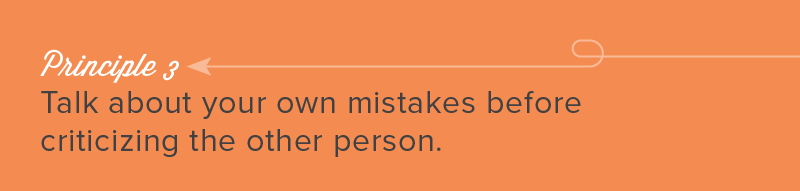
Practise Principle ane: The cardinal is an age-sometime technique called a 'criticism sandwich.' When you're going to offer negative feedback, first with a compliment. Then segue into the meat and potatoes: the criticism. Finally, and more than importantly, office ways with another positive compliment. As Jonah Berger, Wharton professor and New York Times best-selling author, puts it, "Information technology'southward amazing what a little positive at the beginning and end can do." Near of the states answer bitterly to direct criticism. When we're looking to change people without offending them or arousing resentment, only irresolute one three-letter word can be our key to success. Many people begin their criticism with sincere praise followed by the word "but" and their critical argument. For example, a parent trying to convince her son to care more nearly his school work might say, "Nosotros're really proud of you lot, Baton, for getting amend grades this semester.Only if you had worked harder in your math course, you would've done even amend." In this instance, Billy might feel encouraged right up until he hears the word "but," which leads him to question the sincerity of the initial praise. The word "only" makes information technology seem like the praise was only a contrived atomic number 82-in to his mother'south criticism. However, this situation could easily be reversed past changing the word "but" to "and." See how dissimilar it sounds: "Nosotros're really proud of you, Billy, for getting better grades this semester, and if yous continue your efforts next semester, your math course tin be up with all the others." Now it's much easier for Billy to accept the praise, because in that location was no follow-up with direct criticism. The next step to changing people'southward ways without inflicting negative feelings is to admit that we are too susceptible to mistakes. It is much easier to listen to a clarification of our ain faults when the person criticizing begins by humbly saying that he is also far from perfect. Carnegie gives an example of hiring his niece, Josephine, to be his secretary. Josephine fabricated many mistakes on the job, and though Carnegie was tempted to criticize her for her flaws, he took a step back and realized that he is twice as old as Josephine and has 10 yard times her business organisation feel. How could he possibly await her to have his same viewpoint and judgment? He realized that Josephine was performing improve than he had been at her age. When he approached Josephine, he told her that she had made a mistake simply goodness knows it was no worse than many that he himself had made. He noted that she was not built-in with judgment, that information technology comes just with experience, and that he had washed many stupid things himself. "Merely don't you think it would have been wiser if yous had done and so and so?" he concluded.

Carnegie offers an example of an auditor whose business was mostly seasonal. Equally a result, every twelvemonth he had to let a lot of employees go once the tax blitz was over. He began past sitting each downwardly and explaining, "Of class, yous understood you were only employed for the busy season…" only naturally, he was met with disappointment. He then decided to brainstorm the chat past instead telling each employee how valuable he or she had been to the organization, and pointing out specific qualities that he appreciated in them. The result? The employees walked away knowing that if the business had been able to proceed them on, they would have, and they felt much better about themselves. We are so quick to criticize that we seldom offering others the opportunity to salvage face, especially when a considerate word or 2 and a genuine understanding of the other person'due south attitude is all it would take to alleviate the sting. Practise Principle 5: When yous have to deliver a decision or data that will crusade negative feelings, think almost how you can make the person feel good nearly himself get-go. Avoid delivering negative feedback in front of others or setting up a situation that volition be embarrassing for the person. Recollect to yourself, "If I were him, how would I similar to hear this news?" and pattern your environment and your approach accordingly. Take a cursory look back on your ain life to this bespeak. Tin can y'all think of a time when a few words of praise have had a manus in shaping the person you've become? One of the nearly powerful abilities we have is helping others realize their potential. Nosotros tin can do this by praising their strengths. Yet, this is something we do so infrequently. It's much easier to point out someone'due south faults. Even when it'south tough to find things to praise, endeavor difficult to find something. Nosotros should besides praise often. By noting fifty-fifty small steps and pocket-sized improvements, we encourage the other person to keep improving.
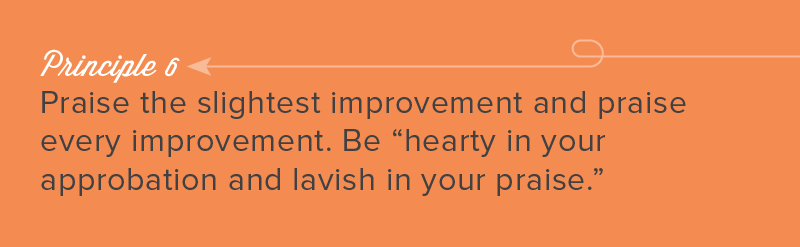
Carnegie offers an example of a mechanic named Bill whose work had get unsatisfactory. Instead of berating or threatening Bill, his manager but chosen Pecker into his office and told him: "You are a fine mechanic, y'all take been in the business concern for many years, and we've had a number of compliments on the adept work you have done. But lately, your piece of work has not been upwardly to your own sometime standards, and I thought you'd want to know since you've been such an outstanding mechanic in the by." The outcome? Bill once once again became a fast and thorough mechanic. With the reputation his manager had given him to live upwards to, how could he not? Practice Principle 7: When y'all're trying to alter someone's listen, requite them a reputation to live upward to by saying something like: "I respect the fact that yous're always willing to heed and are big enough to change your listen when the facts warrant a alter." Appeal to their nobler motives of responsibility, fairness, openness, diligence, etc. If we tell our children, spouses, or employees that they are stupid or bad at a certain thing, have no gift for information technology, and are doing it all wrong, nosotros strip them of any motivation to improve. If instead, we employ the opposite technique and openly encourage them equally they take steps toward improvement, we'll inspire a much higher level of motivation to continue.
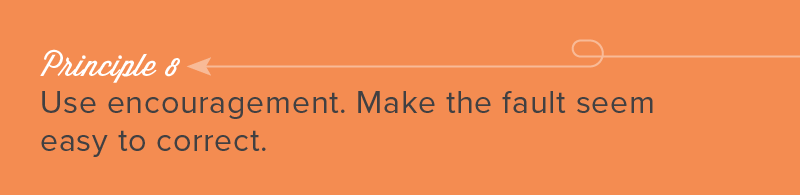
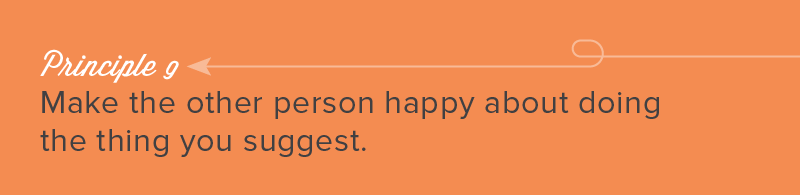
Carnegie offers an instance of a boy who was struggling with algebra. His father made flashcards for him, and every nighttime his father would time him on how long information technology took for him to get all of the cards right. Their goal was to do it in under eight minutes. The first night, it took 52 minutes. The boy thought he'd never get in that location! But every time he knocked off a few minutes - 48, and then 45, 44, 41 - they would call in his mother and the 3 would celebrate and trip the light fantastic toe a little jig. This gave the boy the motivation to go along improving, and even made it fun, until he got so good that he hit his goal and did information technology in eight minutes. Exercise Principle 8: Rather than simply telling someone they're goal is out of achieve, observe ways to encourage pocket-sized victories when possible. These smaller compliments tin can help make room for sharing guidance while keeping them inspired. Whether these pocket-sized victories come up in the grade of eating reese'due south pieces every fourth dimension a work task is complete or dancing a jig when your vocal gets a math, recognizing progress tin can go a long way. The last key to being a leader and irresolute people without arousing resentment is to brand the person happy about doing what we want them to do. If you're having a hard time convincing your child to practice a chore, offer to pay her a dollar for every time she does it, and take abroad a dollar for every time she doesn't. If you lot cull another internal candidate for the job, tell the one who didn't go the job that you felt he was likewise important to the organization in his electric current role to reassign him. If y'all have an employee who struggles with a sure job, appoint her to be the supervisor for that task, and sentinel as she improves immediately. Offering incentives, praise, and authority are all slap-up ways to make a person happily have our decisions and do what we want them to practice. Exercise Principle nine: To be an constructive leader, keep these guidelines in heed when it is necessary to modify attitudes or behavior: 1. Be sincere. Don't hope anything you tin can't deliver. 2. Know exactly what you desire the other person to do. 3. Be empathetic. Ask yourself what it is the other person really wants. 4. Consider the benefits that person volition receive from doing what you suggest. 5. Match those benefits to the person'southward wants. half-dozen. When yous make your asking, put it in a class that volition convey to the other person the idea that he personally will do good. It is naive to call up that by implementing these techniques, we'll always get the outcome we desire. But the experience of most people shows that we are more likely to change attitudes with these approaches than by not using these principles. Even if we increase our success past a mere ten%, we have become x% more than effective as leaders than we were before. With practice, it will get fifty-fifty more natural to utilise these principles every day, and shortly we will be masters of the art of human relations.
Source: https://www.hubspot.com/sales/how-to-win-friends-and-influence-people-summary
0 Response to "How To Win Friends And Influence People Barnes And Noble"
Post a Comment