

How Old Is The Legend Of Zelda
This folio is about the history of The Legend of Zelda series.

Tertiary generation games
The Legend of Zelda, the first game of the serial, was first released in Japan in 1986, and in the United States and Europe in 1987. It used the cartridge's ability to save progress via battery-backed retentivity. The game features a "Second Quest", accessible upon completing the game, where dungeons and the placement of items are different, and enemies are stronger. In 1994, during the terminal years of the Famicom, the game was re-released in cartridge format. A modified version known equally BS The Fable of Zelda was released for the Super Famicom's satellite-based expansion, Satellaview, in the mid-1990s in Japan. BS Zelda was then re-released for the Satellaview again a year later, with re-arranged dungeons and a rearranged overworld.
The 2nd game, Zelda Ii: The Adventure of Link, was released in July 1988 and exchanged the elevation-down perspective for side-scrolling (though the top-downward point of view was retained for times that Link is wandering the overworld), and introduced RPG elements (due east.g., feel points) non found in other Zelda installments. It is also the just Zelda championship excluding Four Swords Adventures in which Link does not collect Rupees. Both this game and its predecessor had gilded-colored game cartridges, instead of the system's usual gray cartridges. Both games were later re-released in the final years of the Nintendo Entertainment System, with gray cartridges.
Fourth generation games
Four years subsequently, The Legend of Zelda: A Link to the Past returned to the top-downwardly view (under a 3/4 perspective), and added the concept of an alternating dimension to explore — a land known equally the Night World. The game was released for the Super Nintendo Entertainment Arrangement in 1991. It was later re-released for the Game Boy Advance on Dec nine, 2002 in North America, on a cartridge with The Legend of Zelda: Four Swords, the first multiplayer Zelda, and and then on the Wii's Virtual Console on January 22, 2007. In addition, both this game (unchanged, except for existence converted into a downloadable format) and an exclusive "loosely-based" sequel which used the same game engine called BS The Fable of Zelda: Ancient Stone Tablets were released on the Satellaview in Nihon.
The next game, The Legend of Zelda: Link'southward Awakening, was the kickoff Zelda game for Nintendo's Game Boy, and the start to accept identify exterior of Hyrule, and not to include Princess Zelda. Information technology was re-released for the Game Boy Color in 1998 equally Link'south Enkindling DX with some additional features, including an extra color-based dungeon and a Camera Shop that allowed interaction with the Game Male child Printer.
Fifth generation games
Afterward some other hiatus, the serial made the transition to 3D with the installment Ocarina of Time, which was released in Nov 1998. This game, initially known every bit Zelda 64, retained the cadre gameplay of the previous 2d games, and became 1 of the well-nigh successful games of all time, in both commercial and critical terms. It is considered by some to be the best video game ever fabricated, and scored perfect scores in several video game publications, including the first 40/40 score in Famitsu, a prestigious Japanese gaming magazine. In 2006, it was ranked by Nintendo Power as the all-time game to ever appear on a Nintendo console. Every bit of October 2007, it holds the number one spot for the best reviewed game in video game history on the Gamerankings and Metacritic review aggregators. The championship was originally slated for the ill-fated, Japanese-just Nintendo 64DD, but was ported to a cartridge when the hardware was delayed. Innovations include the use of lock-on targeting, a new gameplay mechanic that focuses the photographic camera on a nearby target, and alters the role player's actions to be relative to that target. Such mechanics allow precision-based sword fighting in a 3D space, and were a revolutionary development for the time. Like its Nintendo Entertainment Organisation predecessors, Ocarina of Time is notable for being released on a limited-edition aureate cartridge, which was available mainly to those who pre-ordered the game, as well as a regular gray cartridge.
Ocarina of Fourth dimension was re-released on the Nintendo GameCube in 2002, when it was offered as a pre-guild incentive for The Air current Waker in the U.s.a., Canada, and Japan. Europe continues to receive it free in every copy of The Air current Waker, except for the discounted Role player's Option version. Information technology included a previously unreleased Nintendo 64DD expansion known as Ura Zelda in Nihon and Ocarina of Time Master Quest in N America. Ocarina of Time was included as part of Collector's Edition for the GameCube in 2003. It is now available on the Wii's Virtual Panel.
The follow-upwards title, Majora'southward Mask, which was released in November 2000, used the same 3D game engine as Ocarina of Fourth dimension, merely added a novel fourth dimension-based concept, leading to somewhat mixed reactions from series fans. It was originally called Zelda Gaiden, a Japanese title that translates as Zelda Side Story. Gameplay inverse significantly; in addition to a form of fourth dimension-limit, Link could use masks to transform into different creatures with unique skills. While Majora'due south Mask retained the graphical style of the landmark Ocarina of Time, it was likewise a difference, particularly in terms of its overall temper. It also featured motion-blur, dissimilar its predecessor, Ocarina of Time. The game is much darker, dealing with death and tragedy in a way not previously seen in the series, and has a sense of impending doom, every bit a big moon slowly descends upon the land of Termina. All copies of Majora'due south Mask are gilt cartridges. A "Limited Collector'due south Edition" lenticular cartridge characterization was offered as the pre-gild incentive. Copies of the game that weren't collector's editions featured a more than traditional sticker cartridge label.
The next two games, The Legend of Zelda: Oracle of Seasons and Oracle of Ages, were released simultaneously for the Game Boy Colour, and interact using passwords or a Game Link Cable. After i game has been completed, the player is given a password that allows the other game to be played every bit a sequel. They were developed by Flagship in conjunction with Nintendo, with supervision from Shigeru Miyamoto. After the team experimented with porting the original Fable of Zelda to the Game Boy Color, they decided to make an original trilogy to exist called the "Triforce Serial". When the password organization linking the 3 games proved too troublesome, the concept was reduced to two titles at Miyamoto's suggestion. These two titles became Oracle of Ages, which is more puzzle-based, and Oracle of Seasons, which is more activity-oriented.
Sixth and 7th generation games
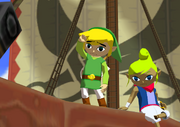
The cel-shaded art-style of The Current of air Waker
When Nintendo revealed the Nintendo GameCube on August 24, 2000, a software demonstration showed a realistically-styled existent-time duel between Ganondorf and Link. Fans and the media speculated that the boxing might be from a Zelda game under development. At Spaceworld 2001, Nintendo showed a cel-shaded Zelda title, subsequently released as The Wind Waker, which Miyamoto felt would "extend Zelda's reach to all ages". To Miyamoto'southward surprise, the media reported that Zelda was shifting to a younger audience. Nothing farther was shown until a playable demonstration was ready, which was well-received. The gameplay centers on controlling wind with a baton called the "Air current Waker", and sailing a small boat around a massive, island-filled ocean.
Next in the series came Four Swords Adventures for the GameCube, which was released in the showtime one-half of 2004 in Nihon and America and in January 2005 in Europe. Based on the handheld 4 Swords, Four Swords Adventures was some other divergence from previous Zelda gameplay, focusing on multiplayer gameplay and "level-based" activity. The game contains 24 individual stages and a map screen; at that place is no connecting overworld. For the multiplayer features of the game, each player is required to use a Game Male child Advance system linked to the Nintendo GameCube via a special cable. Although it focuses on multiplayer, the game likewise features a unmarried-player entrada, in which using a Game Male child Advance is optional.
Four Swords Adventures is really two games in 1: Hyrulean Chance (with a storyline and action somewhat similar to a traditional Zelda chance) and Shadow Battle (a free-for-all mêlée "battle fashion", which pits Links against each other as the players struggle for dominance in Hyrulean arenas). The Japanese version includes a third segment, known equally Navi Trackers (originally designed every bit the stand-alone game Tetra'due south Trackers), which is not included in whatsoever other incarnation of the title. Navi Trackers contains spoken dialogue for near of the characters, a kickoff for the Zelda serial.
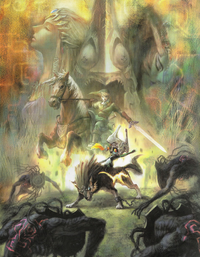
An official Twilight Princess illustration
In Nov 2004 in Japan and Europe, and in Jan 2005 in America, Nintendo released a new game for the Game Male child Advance, The Minish Cap. The central concept of The Minish Cap is Link's ability to shrink in size with the assist of a mystical sentient hat named Ezlo. While tiny, Link can see previously-explored parts of a dungeon from a new perspective, and enter new areas through otherwise-impassable openings. Link is able to switch from big to small at special portals throughout the land, over again giving Link two "worlds" to play in.
In Nov 2006, Twilight Princess arrived equally the beginning Zelda game on the Wii, and later, in December 2006, on the Nintendo GameCube, the system for which it was originally developed. The game once again strives for a realistic look, improved fifty-fifty across the same SpaceWorld demo. It chronicles the struggle of a more mature Link to rid Hyrule of the "Twilight Realm", a mysterious force plaguing the country. When he enters this realm, he is transformed into a wolf, and the gameplay shifts radically. Twilight Princess also relies heavily on horseback transportation and mounted battle scenarios, including dominate battles.
"Zelda DS" was once rumored to be a new Four Swords game, but Nintendo later retracted those statements. Instead, at the 2006 Game Developers Briefing, a trailer for Phantom Hourglass for the Nintendo DS was shown. The trailer revealed traditional summit-downwards Zelda gameplay optimized for the DS' features, with a cel-shaded graphical manner similar to The Air current Waker. At the 2006 Electronic Entertainment Expo, Nintendo confirmed its status as a direct sequel to The Air current Waker, and debuted an extensive playable demo, including a multiplayer manner reminiscent of Pac-Homo Vs. with "capture the flag" elements. Phantom Hourglass was released on June 23, 2007, in Japan; Oct ane, 2007, in North America; and October 19, 2007, in Europe.
On September 10, 2007, Nintendo announced a new spin-off game in The Legend of Zelda series, Link's Crossbow Grooming. It was packed in with Nintendo'southward Wii Zapper peripheral, and released on Nov nineteen, 2007 in North America.
On March 25, at the 2009 Game Developers Briefing, Satoru Iwata announced a new Zelda game for the Nintendo DS, The Legend of Zelda: Spirit Tracks. The game was released on December seventh, 2009 in N America, and on December 23rd, 2009 in Nihon. The basic premise of the game takes place on railroad, and as a new add-on to the series, in certain areas Princess Zelda's deportment can besides be controlled.
In November 2011, The Fable of Zelda: Skyward Sword was released worldwide. This game passed to be, according to its plot, the first in the Fable of Zelda timeline.
Eighth generation games
In November 2013, The Legend of Zelda: A Link Between Worlds was released as a sequel to A Link to the By on the Nintendo 3DS.
On December 18, 2013, Nintendo announced a spinoff title, Hyrule Warriors, for the Wii U. Hyrule Warriors volition exist released in Japan on August 14, 2014.
At the 2014 Electronic Entertainment Expo, Nintendo showed the first trailer for The Legend of Zelda: Breath of the Wild, and confirmed a 2015 release. This was after pushed back for a possible 2016 release. Currently, it has been delayed to a 2017 release.
During Nintendo's 2015 E3 Digital Event, a offset await and gameplay trailer for The Fable of Zelda: Tri Force Heroes was shown, forth with a fall 2015 release. Tri Force Heroes was shown to have nearly identical aesthetics to A Link Betwixt Worlds, only with a heavy emphasis on co-op play.

How Old Is The Legend Of Zelda,
Source: https://zelda-archive.fandom.com/wiki/History_of_the_Legend_of_Zelda_series
Posted by: smithallind62.blogspot.com
0 Response to "How Old Is The Legend Of Zelda"
Post a Comment